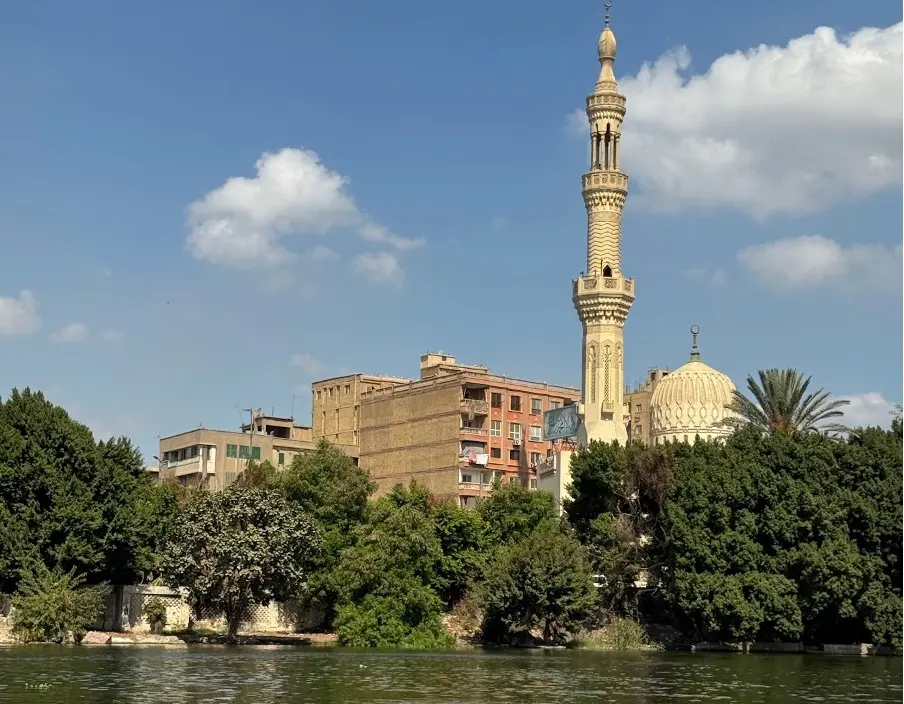
Immersed in Cairo’s Living Landscapes: Reflections from LRG’s 2025 Critical Field Study
The Landscape Research Group’s 2025 Critical Field Study brought twenty members from across the world together in Cairo between 19–25 September, offering an intensive, place-based...
The Landscape Research Group’s 2025 Critical Field Study brought twenty members from across the world together in Cairo between 19–25 September, offering an intensive, place-based exploration of one of the world’s most complex urban environments. Designed and led by LRG Trustee Merham Keleg with Nada Samir and Dalia Aly, the five-day programme invited participants to encounter Cairo’s landscapes through historical, ecological, and contemporary urban lenses.
The field study formed part of LRG’s wider commitment to connecting research, practice and place. Over the course of the week, participants engaged with sites ranging from the city’s botanical heritage and Islamic urban fabric to the shifting ecologies of the Nile and the rapidly expanding landscapes of New Cairo.

A layered introduction to Cairo (Days 1–2)

The programme opened with orientation and a visit to Mazhar Botanical Park, providing the group with an early grounding in Cairo’s botanical traditions and water–land relationships. Later the same day, the group travelled to the Pyramids of Giza, where they explored the early landscapes of the pyramids and the current questions of heritage, and tourism.
The second day focused on Islamic Cairo, moving through Al-Hakim Mosque, Moez Street, and Bayt al-Suhaymi, before progressing to the City of the Dead and ending in al-Azhar Park. These transitions between dense historic streets, living heritage sites and contemporary public spaces offered participants a close-up view of how Cairo’s cultural landscapes continue to evolve.
Blue ecologies and island settlements (Day 3)
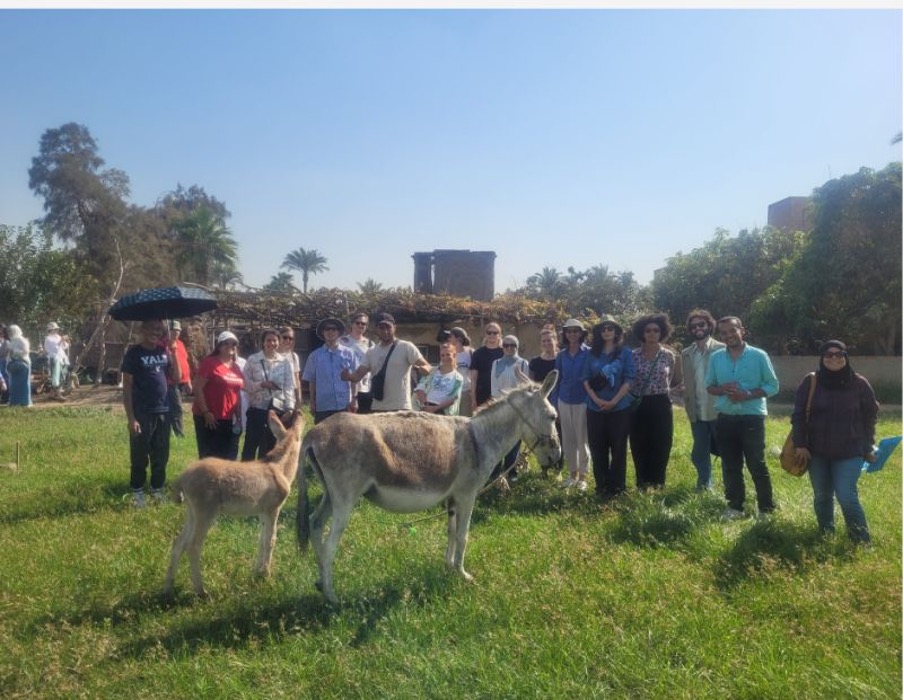
The third day centred on Cairo’s riverine landscapes. A guided Nile tour introduced the city’s “blue ecologies”, followed by an afternoon on Qursaya Island, where agricultural fields, settlement patterns and local livelihoods offered a contrasting perspective to the intensification of the mainland. Participants also visited a recycling initiative that works with local fishermen to collect plastic waste from the river before regrouping for an evening reflection session.
One participant, Dr Mohamed Akl, reflected that stepping outside his disciplinary comfort zone – remote sensing and groundwater – reshaped how he understood the interconnections between water, landscape and community. The field study, he wrote, “gave me the chance to explore Cairo’s rich historical, social, and ecological landscapes… a perspective I will carry into my own research” .
Desert edges, archaeological layers and urban expansion (Day 4)
On the fourth day, the group explored the botanic and residential landscapes of Maadi, before travelling to al-Fustat, one of Cairo’s most significant archaeological and cultural zones. Afternoon discussions with local consultants provided further context on the complexities of managing heritage, development and environmental pressures in one of the city’s oldest districts.
The day concluded at Wadi Degla Protectorate, where an environmental guide and a representative from Environment Without Borders led a walk through the desert valley. This shift from dense urban space to expansive geological landscapes highlighted the dramatic environmental gradients that coexist within Greater Cairo.

Green initiatives and new cities (Day 5)
The final day of the programme moved eastwards to emerging urban districts. A visit to the community-based green-space revitalisation initiative in Mahaba Square demonstrated the importance of local stewardship in shaping everyday landscapes. This was followed by talks and a campus tour at the American University in Cairo, before the group travelled to Madinaty, one of the region’s major new development projects, to consider the design logics and lived realities of contemporary planned settlements.
Participants consistently described the week as generative and deeply collaborative. Professor Noha Abd el-aziz remarked that the study “offered a unique opportunity to explore the layered landscapes of Cairo… paving the way for future partnerships, collaborations and research outputs”.
A collective learning experience

Across the programme, participants engaged with Cairo as a constellation of living, negotiated landscapes: agricultural islands, historic urban cores, desert margins, blue corridors and expanding new towns. Conversations unfolded in courtyards, on boats, in archaeological sites, across botanical walks and during shared meals. For many attendees, the diversity of academic and professional backgrounds – from landscape architecture and hydrology to cultural geography and urban design – enriched the experience.
All attendees were LRG members, underscoring the importance of membership as a space for exchange and collaboration. As Dr Akl noted, “Every conversation was meaningful” and contributed to a growing network of global landscape researchers.
Looking ahead
The Cairo Critical Field Study forms part of LRG’s ongoing dedication to fostering international research exchange through field-based learning. Information on future field activities will be announced via the LRG newsletter, website and member channels.
Further reading:
- LRG International Research Networks Update
- Borderscapes as an approach for understanding green belts in an ever-growing metropolitan: the case of Cairo, Egypt
Keleg M. Landscape Research. Published online 14 November 2025. - Rethinking ‘future nature’ through a transatlantic research collaboration: climate-adapted urban green infrastructure for human wellbeing and biodiversity
Hoyle HE, Gomes Sant’Anna C. Landscape Research. 2023; 48(4). Published online 27 October 2020. - ‘Digging in the water?’ Grassroots urbanism, the Egyptian state, and the politics of heritage-making in post-revolution Cairo.
Panetta, C. (2020). International Journal of Heritage Studies, 26(12), 1221–1239.
Enjoyed reading this trustee Q&A but not yet a member?
Becoming an LRG member means you can help shape the organisation’s future. Members can vote in Board of Trustees elections and even stand for election themselves.
You’ll also enjoy a rage of benefits: access to our peer-reviewed journal Landscape Research plus five other publications, eligibility to apply for the LRG Research Fund, the chance to join Critical Field Studies, and opportunities to share your work within a truly global community.
If you’re not yet a member, there’s never been a better time to join and get involved.
Back to the library
Browse essays, films and field studies from across the network.