Covid thoughts: Inequality and access to green space in England
This blog series is a space to share thoughts and musings arising from the Covid-19 pandemic, and its impacts on current and future landscapes.
This piece is submitted by Peter Howard, former editor of our journal Landscape Research and vice-chair of LRG.
Landscape has never been more critical to the mental health of the country, but I fear that, as with most valuable commodities, it is part of the problem of inequality and not part of the solution – although there were major attempts in England in previous years, with spacious council house gardens and allotments, to reverse that position.
First there are those of us with private gardens. We have never been more grateful for the habit of living at ground level, with gardens, rather than in apartments, but of course we have moved the poor into apartments with little outdoor access.
We have some public parks, but not enough, and grossly under financed. Many have had to be closed as the municipal authorities do not feel able to trust people to police themselves, and cannot afford to police themselves. Much the same can be said of the many outstanding landscapes in the hands of the National Trust and similar bodies. In any case taking a bus to the park is probably not an ‘essential’ journey. Our other national habit of only thinking of leisure landscape as being rural or at least green has meant that there are few squares and urban leisure spaces not overrun as carparks.
We rural people have our footpaths, and self distancing does not seem a problem, but to get to the footpath you either need a car, or you must dice with lanes which either have too much traffic, or traffic that’s too fast.
A few can walk to the coast, but it is largely inaccessible without a vehicle and most activities are curtailed to save the resources of the police or the Royal National Lifeboat Institution.
We designated National Parks to provide places for the populace to ramble keeping sufficient distance, but we insisted on honeypot carparks where such distancing is impossible, so the National Parks are only available to the wealthy who are the only ones who can afford houses within the Park.
The European Landscape Convention reminds us that all landscapes are important, urban and rural, ordinary as well as outstanding, but I fear that even the most banal landscape is no longer available to the poor.
If you’d like to submit a response, or your own thoughts on Covid-19, be it writing, images, audio or video, please write to Sarah: sarah.hobbs@landscaperesearch.org.
More from around this time
More news
All news
News · 3 September 2026
New podcast revisits Laura Alice Watt’s The Paradox of Preservation as its tenth anniversary approaches
LRG Chair Professor Laura Alice Watt joins the *In Common* podcast to revisit 'The Paradox of Preservation' as the book approaches its tenth anniversary—and to consider
News · 28 August 2026
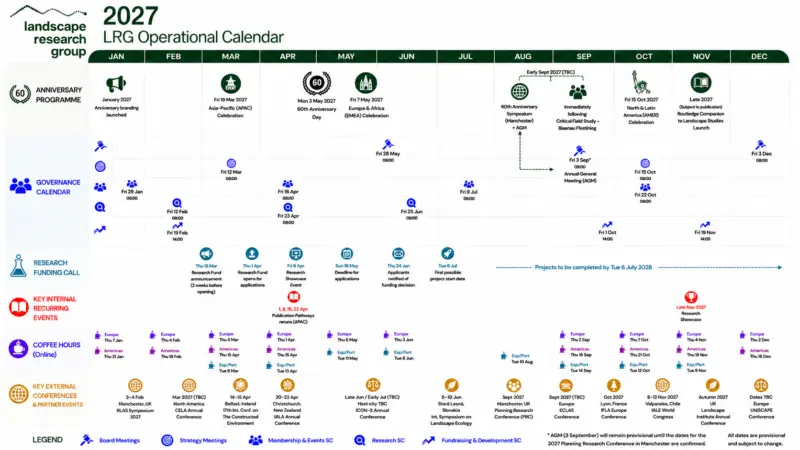
LRG at 60: our 2027 anniversary programme
Explore the developing programme for LRG’s 60th Anniversary year, including regional celebrations, research and network activities, and our proposed flagship gathering in September 2027. Discover the
News · 21 August 2026
Help shape the proposed Natural History GCSE for England
LRG members are invited to contribute their expertise to a UK Government consultation on the proposed Natural History GCSE for England, with particular opportunities to inform
Get stories like this by email
The newsletter carries the quarter’s best of these, straight to your inbox.